Total Testosterone
600–1,000
ng/dL — where most men feel well
TRT Reference · Updated June 2026
The difference between a TRT protocol that works and one that doesn't isn't the dose. It's whether you can see the trend across six months of blood draws, logged against every protocol change you made.
The Core Reference Numbers
These are the four values that determine whether a TRT protocol is working and whether it's safe. They move together — optimizing one affects the others. Track all four at every blood draw.
Total T is the number most men focus on. Free T is what actually matters for receptor activity — roughly 2–3% of Total T is bioavailable. A man with 900 ng/dL Total T and high SHBG may have less usable testosterone than someone at 650 with low SHBG. Estradiol rises on TRT through aromatase conversion — the question is whether it rises far enough to cause symptoms. Hematocrit rises more slowly, but unchecked it creates meaningful thrombosis risk above 52–54%.
What to Track
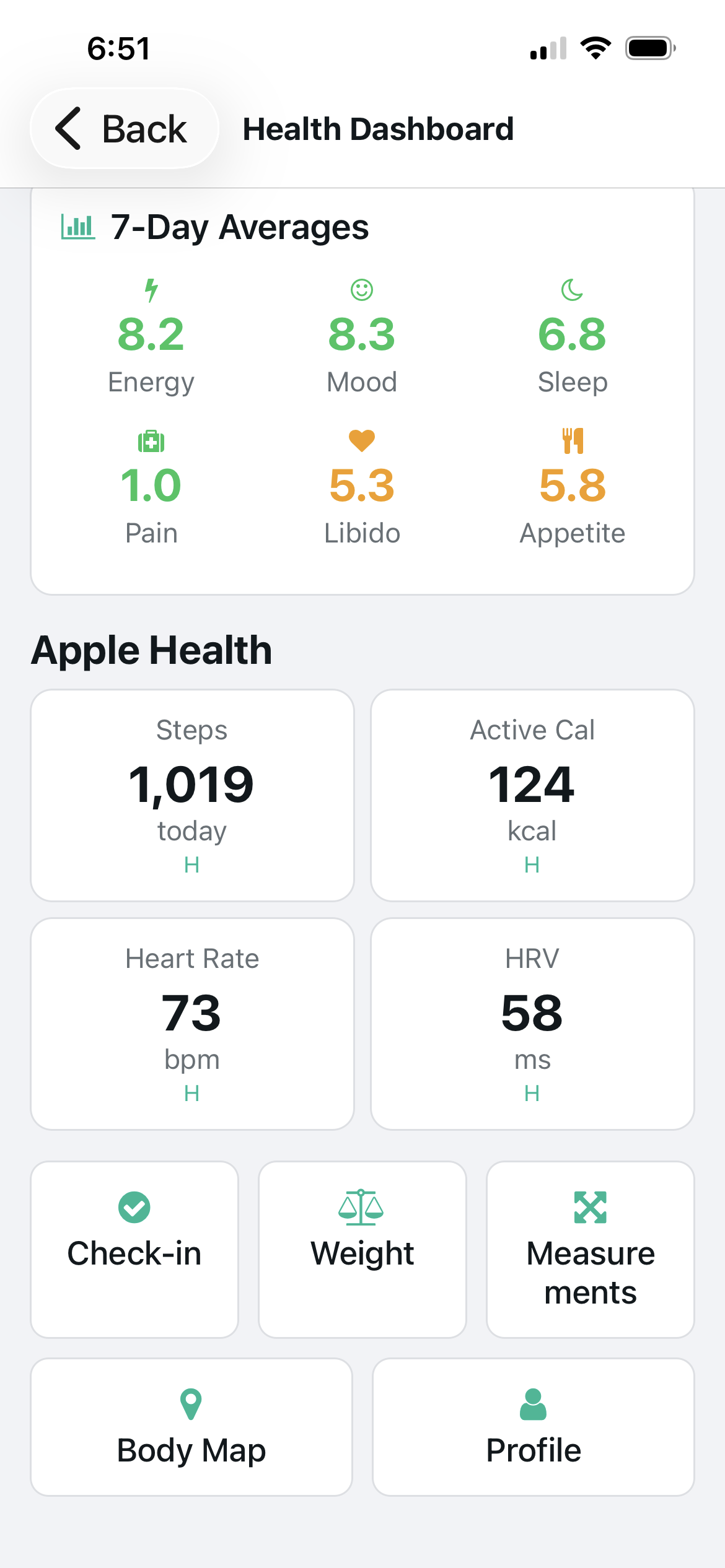
Protocol tracks labs, dose history, and health metrics in one view
Date, time, dose in mg, ester type, injection site. Rotation matters for consistent absorption. The injection log is the baseline against which you interpret every blood draw.
Test mid-week if you inject twice weekly (Monday/Thursday). Aim for 24 hours post-injection for Cypionate or Enanthate. Testing too close to injection shows a peak, not the steady-state. Consistent timing makes your draw-to-draw comparison meaningful.
Record Total T, Free T, Estradiol (sensitive), Hematocrit, Hemoglobin, PSA, and SHBG alongside the exact protocol you were running at that draw date. The context is what turns a number into information.
A single Total T of 750 ng/dL means nothing without context. Three consecutive draws at 750–800 ng/dL while feeling optimal means your protocol is calibrated. Hematocrit at 49% is fine; hematocrit trending from 44% to 47% to 49% over three draws is a signal.
Bloodwork Reference
| Marker | Clinical Target | Test Frequency |
|---|---|---|
| Total Testosterone | 600–1,000 ng/dL | Every 90 days |
| Free Testosterone | 15–25 pg/mL | Every 90 days |
| Estradiol (sensitive assay) | 20–40 pg/mL | Every 90 days |
| Hematocrit | Below 52% | Every 90 days |
| Hemoglobin | Below 17.5 g/dL | Every 90 days |
| PSA | Below 4.0 ng/mL | Annually (men 40+) |
| LH / FSH | Near zero (expected) | Baseline only |
| SHBG | 20–50 nmol/L | Baseline, then annually |
Test at baseline before starting. At 6–8 weeks after any protocol change. Every 90 days when stable. Not medical advice — work with your prescriber on your specific targets.
The Tool
Protocol is the only full-featured TRT tracker on Android as of 2026. It logs injections (dose, ester, site), bloodwork values (Full TRT panel), symptoms, and health metrics in one view. The TRT ester calculator shows the free testosterone content of every major ester — 200mg of Testosterone Cypionate delivers approximately 140mg of actual testosterone. See the full TRT bloodwork guide at trttracker.health/trt-bloodwork-guide.
No account required. Data stored on-device only. Available on iOS and Android. The testosterone ester calculator and HCG guide are available as reference pages: testosterone ester calculator → | HCG on TRT →
Common Questions
TRT logging, bloodwork tracking, ester calculator. iOS + Android.


No account · On-device only · Free